At Waddesdon Manor, Art Is Being Handed Back To Nature
Art in Nature returns to Waddesdon Manor with installations designed to disappear. James Brunt's 70-metre mandala leads ephemeral works across the grounds.
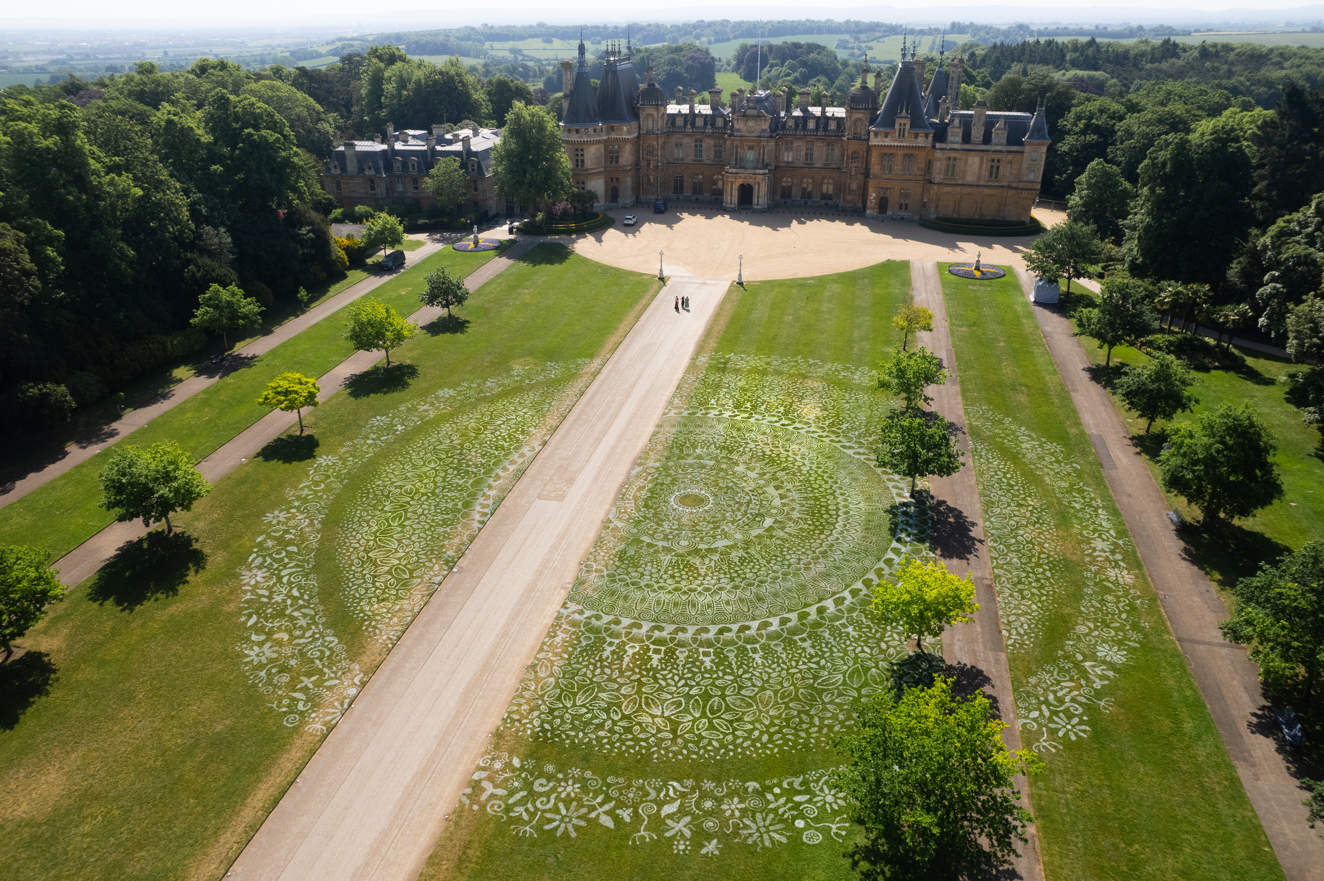
There is something refreshingly unfashionable about the idea that art might not last.
Much contemporary culture is obsessed with permanence, preservation and visibility. Images are archived endlessly, exhibitions become content and even landscapes increasingly feel curated for photography rather than experience. Yet at Waddesdon Manor this month, one of Britain’s most quietly ambitious art festivals is built around precisely the opposite idea.
Art in Nature, now returning for its second year, invites artists to create works designed not to endure, but to disappear.
At the centre of the festival sits a vast seventy metre mandala spread across the North Front lawn, created collaboratively by Yorkshire land artist James Brunt and Pembrokeshire based artist Jon Foreman alongside Mark and Eric Ford. Inspired partly by the architectural detailing of the Manor itself, the installation expands outward into increasingly organic and nature driven patterns, blurring the boundary between formal design and natural landscape.
It is visually spectacular, certainly, but spectacle is not really the point.
The real appeal of Art in Nature lies in its refusal to separate creativity from environment. These are not artworks imposed aggressively onto the landscape, but temporary interventions emerging from it. Stones, leaves, willow, grasses and reclaimed natural materials become both medium and message.
And crucially, the works are ephemeral.
Brunt, whose practice has made him one of Britain’s leading land artists, has long embraced impermanence as central to his philosophy. His installations are intentionally temporary, designed to return quietly to the natural world soon after completion. In another era such an approach might have felt romantic. Today it feels almost quietly radical.
There is a growing appetite for precisely this kind of experience.
As modern life becomes increasingly digital, frictionless and screen based, audiences appear increasingly drawn toward forms of creativity rooted in tactility, slowness and direct engagement with landscape itself. Land art, once occupying a niche space within environmental practice, now feels culturally aligned with broader anxieties surrounding ecology, overstimulation and disconnection from nature.
Art in Nature understands that instinctively.
Visitors are encouraged not merely to observe the artworks, but to participate in them through workshops, collaborative installations and temporary community creations spread throughout the grounds. The atmosphere feels less like a conventional sculpture exhibition and more like a large scale act of collective attention.
That communal aspect matters.
Pippa Shirley, Director of Waddesdon, describes the festival as a celebration not simply of creativity, but of the relationship between people and place. “It makes us recognise not only the beauty of the natural world but also its essential role as a habitat for wildlife,” she said ahead of the event.
Importantly, the environmental messaging never becomes heavy handed.
Unlike much contemporary eco art, which often risks collapsing into moral instruction, Art in Nature works because it prioritises wonder first. Visitors encounter precariously balanced stone sculptures, vast sand drawings and intricate natural mandalas before they encounter any broader ecological meaning. The emotional connection arrives ahead of the lecture.
That balance feels increasingly rare.
The range of artists participating reinforces the festival’s unusually open spirit. Alongside established environmental artists such as Richard Shilling and Rebecca and Mark Ford, the programme includes disability activist and artist Sam Cleasby, Portuguese mandala artist Ana Castilho and ambient musician Andy Whitehouse, whose live looping compositions respond directly to the surrounding landscape and activity.
What emerges is not a rigid curatorial statement, but something looser and more humane.
In many ways, the setting itself explains why the festival works so effectively. Waddesdon Manor has always occupied an unusual position within Britain’s cultural landscape, simultaneously aristocratic spectacle, historic house and carefully choreographed fantasy. Art in Nature temporarily disrupts that formality, allowing the grounds to feel playful, unstable and alive again.
And perhaps that is why the festival feels unexpectedly moving.
The artworks will vanish. The leaves will decay, the stones will shift and the weather will eventually erase much of what has been created.
But for a brief period, the landscape itself becomes the gallery.
Continue Reading
More Culture
Jeanette Mundt Paints For An Age That No Longer Trusts Images
World Monuments Fund Returns To Italy With A Restoration Project Shaped By War, Memory And Reinvention
Mat Collishaw’s Death Row Paintings Turn America’s Final Meals Into Modern Vanitas
Constable’s Suffolk Returns Home As The Hay Wain Travels East

Stories worth your
weekend.
A handpicked dispatch from Hinton's editors. The long reads, the people, the openings, the things worth knowing. No filler.