World Monuments Fund Returns To Italy With A Restoration Project Shaped By War, Memory And Reinvention
World Monuments Fund opens first permanent Italy office, launching restoration of Milan's Golden Room at Poldi Pezzoli Museum—a 19th-century space scarred by 1943 Allied bombing.
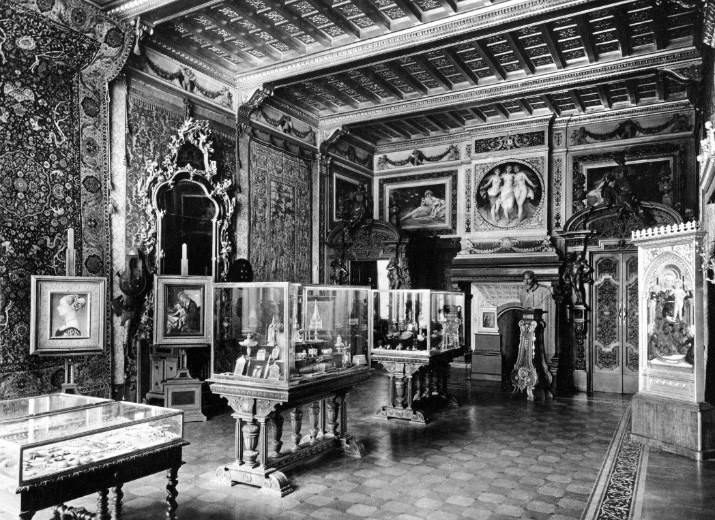
The Golden Room at the Poldi Pezzoli Museum in Milan in 1883. Photo: Montabone.
For an organisation devoted to preserving the past, there is a certain symmetry in World Monuments Fund returning formally to the country where much of its modern identity was first forged.
Nearly sixty years after the catastrophic floods of Venice helped define the organisation’s early international mission, World Monuments Fund has announced the opening of its first permanent office in Italy, alongside the launch of a significant new restoration project in Milan. The decision feels less like expansion than homecoming.
The inaugural project will focus on the Golden Room at Poldi Pezzoli Museum, one of Europe’s great nineteenth century house museums and an institution long admired for its pioneering approach to displaying art within immersive historical interiors.
The room itself carries the marks of both cultural ambition and historical violence.
Originally conceived by collector Gian Giacomo Poldi Pezzoli as an integrated architectural environment for Renaissance masterpieces, the Golden Room helped establish the “period room” concept later adopted by institutions such as the Isabella Stewart Gardner Museum in Boston and The Frick Collection in New York. Yet much of that vision was shattered during Allied bombing in 1943, with subsequent postwar alterations further obscuring its original design.
World Monuments Fund now intends to recover the room’s architectural coherence, reuniting dispersed decorative elements while revealing details hidden for decades beneath later interventions.
It is a restoration project, certainly, but also something broader.
Increasingly, the most interesting heritage work no longer treats buildings simply as objects to preserve, but as layered records of conflict, memory and cultural change. The Golden Room’s significance lies not only in what it once looked like, but in the traces left by destruction and reconstruction themselves.
That wider sensitivity feels characteristic of the direction World Monuments Fund has increasingly taken in recent years.
The organisation’s relationship with Italy stretches back to the aftermath of the 1966 Venice floods, when founder Colonel James Gray mobilised international conservation expertise to help rescue damaged churches, artworks and archives. In the decades since, the organisation has contributed more than $23.5 million toward heritage projects across the country, ranging from archaeological sites and synagogues to cathedrals and museums.
Italy, in many ways, became the testing ground for modern international conservation practice itself.
“Italy is where the history of World Monuments Fund began,” said Fiorella Ballabio, Executive Director of World Monuments Fund Italy. “For me, cultural heritage is something alive and deeply human, capable of preserving memory, identity and meaning across generations.”
That language feels notable.
There was a time when heritage organisations often spoke primarily in the language of preservation and technical expertise. Increasingly, however, cultural conservation is framed in emotional and civic terms, not merely protecting monuments, but protecting continuity itself in societies increasingly shaped by speed, instability and erasure.
Milan proves a particularly fitting place for this next chapter.
The city’s cultural identity has long balanced historical preservation against modern reinvention more aggressively than many Italian counterparts. The Poldi Pezzoli Museum embodies that tension perfectly, a nineteenth century vision interrupted by twentieth century war and now reconsidered again through contemporary conservation philosophy.
What makes the project compelling is that it does not appear interested in simply recreating an untouched past.
Instead, interpretation will form a central part of the restoration, acknowledging the room’s layered history rather than attempting to erase it entirely. The scars of history remain part of the story.
And perhaps that is what the strongest restoration projects increasingly understand.
Heritage is rarely static. It survives through adaptation, damage, repair and reinterpretation. The goal is not always to return places to perfection, but to help modern audiences understand the lives, histories and ruptures embedded within them.
In that sense, the reopening of World Monuments Fund’s Italian office feels symbolically appropriate.
Not simply a return to Italy, but a return to the idea that cultural preservation remains one of the most human ways societies attempt to hold onto themselves.
Continue Reading
More Art & Design
Joan Eardley’s North Sea Paintings Still Feel Wild Enough To Blow You Over
Mat Collishaw’s Death Row Paintings Turn America’s Final Meals Into Modern Vanitas
Constable’s Suffolk Returns Home As The Hay Wain Travels East
Why Art Basel Is Turning To Trees In Search Of Calm

Stories worth your
weekend.
A handpicked dispatch from Hinton's editors. The long reads, the people, the openings, the things worth knowing. No filler.