Before the Mind Steps In: Simona Ray on Intuition, Instinct, and Letting the Work Arrive
Discover Simona Ray's unique approach to art in 'Before the Mind Steps In.' Explore how Simona Ray trusts intuition over control.
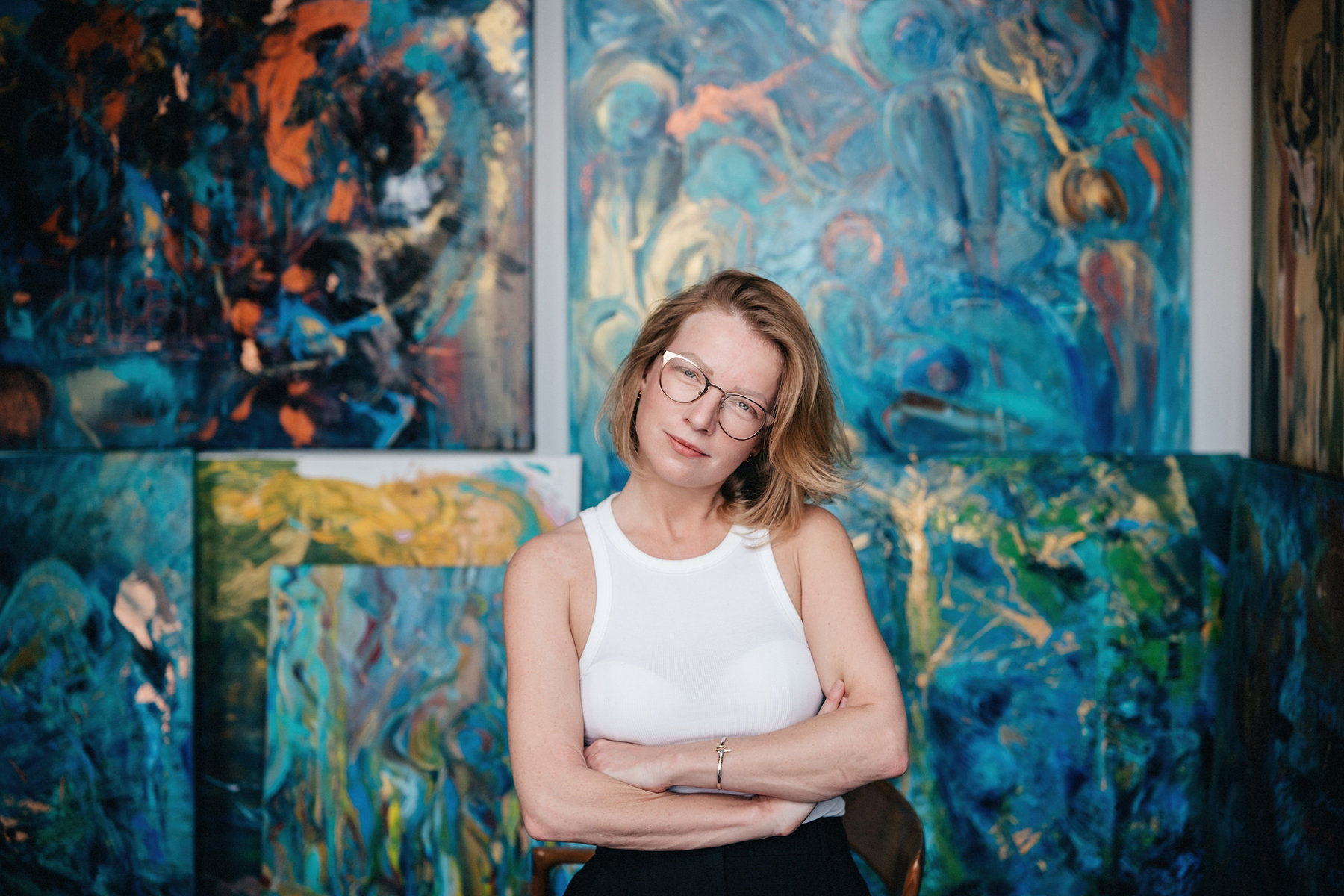
There is a moment in every creative process where control has to be let go. Most people never reach it. Or they reach it and pull back.
For Simona Ray, that moment is where the work actually begins.
This third conversation in the series moves deeper into her practice. Not the finished paintings, not the mythology, but the way they come into existence in the first place. Instinct over structure. Feeling over form. The quiet decision to trust something you cannot fully explain.
In a world that rewards precision, credentials, and polished outcomes, Ray’s approach feels almost countercultural. She is not chasing perfection. She is listening for something more honest. Something that arrives before the mind has time to shape it into something acceptable.
What unfolds here is not just a conversation about art. It is about what happens when you stop trying to control the outcome and allow something real to surface.
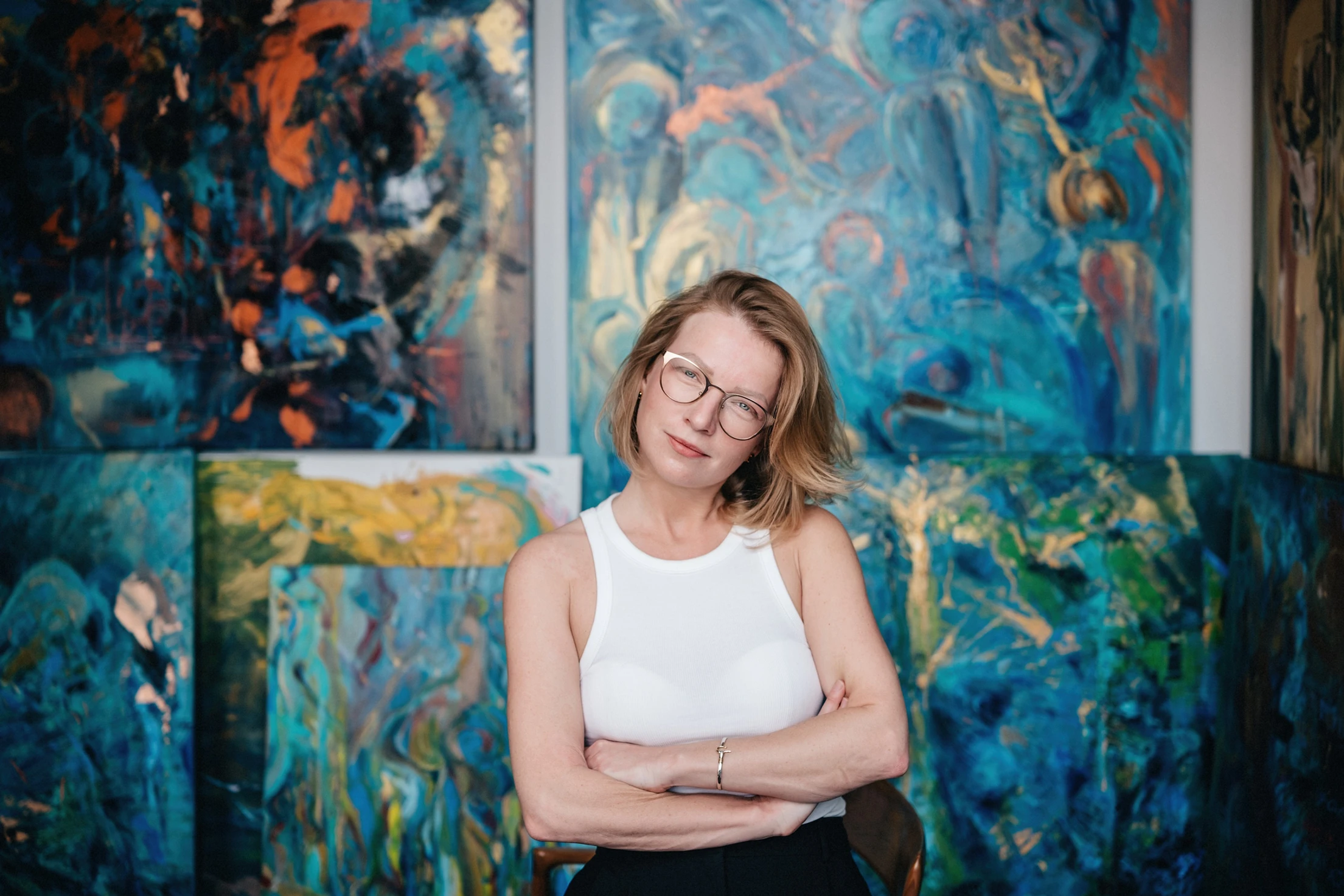
You often create from feeling before form. When you begin a painting, what tells you where to start if there is no fixed plan?
The canvas tells me. Something moves through me toward it.
I arrive with a blank mind. My hand reaches for colours and tools — I am not choosing. It feels like my hand is already knowing.
My practice is called Sentient to Paint. Sentient is not just a word for me. It is a description of an ability to feel. However, for me it has much deeper meaning than “sentience”.
I do not paint what I see. My mind cannot paint what only the feeling or intuition can know at that given moment. The brain must switch off entirely. And then it just arrives. When I try to direct it, when the thinking mind steps in and decides what the painting should become — I ruin it.
It feels like unconsciously receiving instructions. From where, I cannot say. But I have learned to follow them without needing to understand the direction.
The same is true when I paint someone’s inner world. Commissioned work of inner landscapes, and stories of others.
I do not paint how those beautiful people look. I begin with clearing my mind and following my intuition. Like I would get into a meditative state. And my hand starts to paint. Or I go to the kitchen for sponges, I have an urge to go and spray paint on a terrace at the least suitable moment. It is like I do not feel but my intuition does.
It is the only tool that reaches that far.
In a world that measures art through training, credentials, and perfection, what does it mean to you to prioritise instinct over technique?
It means accepting a different kind of authority.
The world of credentials offers a map, certain territory. Technique is centuries of accumulated wisdom. I respect that inheritance deeply. I was trained at an art grammar school. I know what the map says.
But the map does not mean we have to follow it. We can explore our own ways. We are not obliged to follow somebody else’s journey. I believe that in art this applies even more.
I used to carry a deep fear of not being good enough and it was holding me quietly. I used to compare myself to others. My mind used to be my worst enemy — moments when my brain started overthinking something that is shaped by the subjective views of others. I believe that most of us are formed by opinions, expectations, paths, and judgements.
I have been working with a Jungian life coach for a while. I am finding my real self. And with every undoing of something from the past, I feel lighter. Less full of clutter.
Once I stopped utilising my brain and allowed myself to feel, to be guided, my style of painting changed. I did not become better. I became more myself. And my art became more authentic. It offers something different than I ever imagined.
I paint with metallic colours, I add them intuitively as I do everything else. I realised that a wobble in a line, an imperfect shape, means something under differently coloured light. That stroke which breaks the rule suddenly also breaks the view of a singular reality. Viewers can see so many different things under different lights, that even I sometimes stand in front of my paintings wondering how those things got there.
I realised that nothing is a mistake. Everything happens for a reason.
An open mind creates a new reality.
The world asks all of us to perform a finished version of ourselves. Something that is alive gets lost in that performance — before it ever has the chance to arrive.
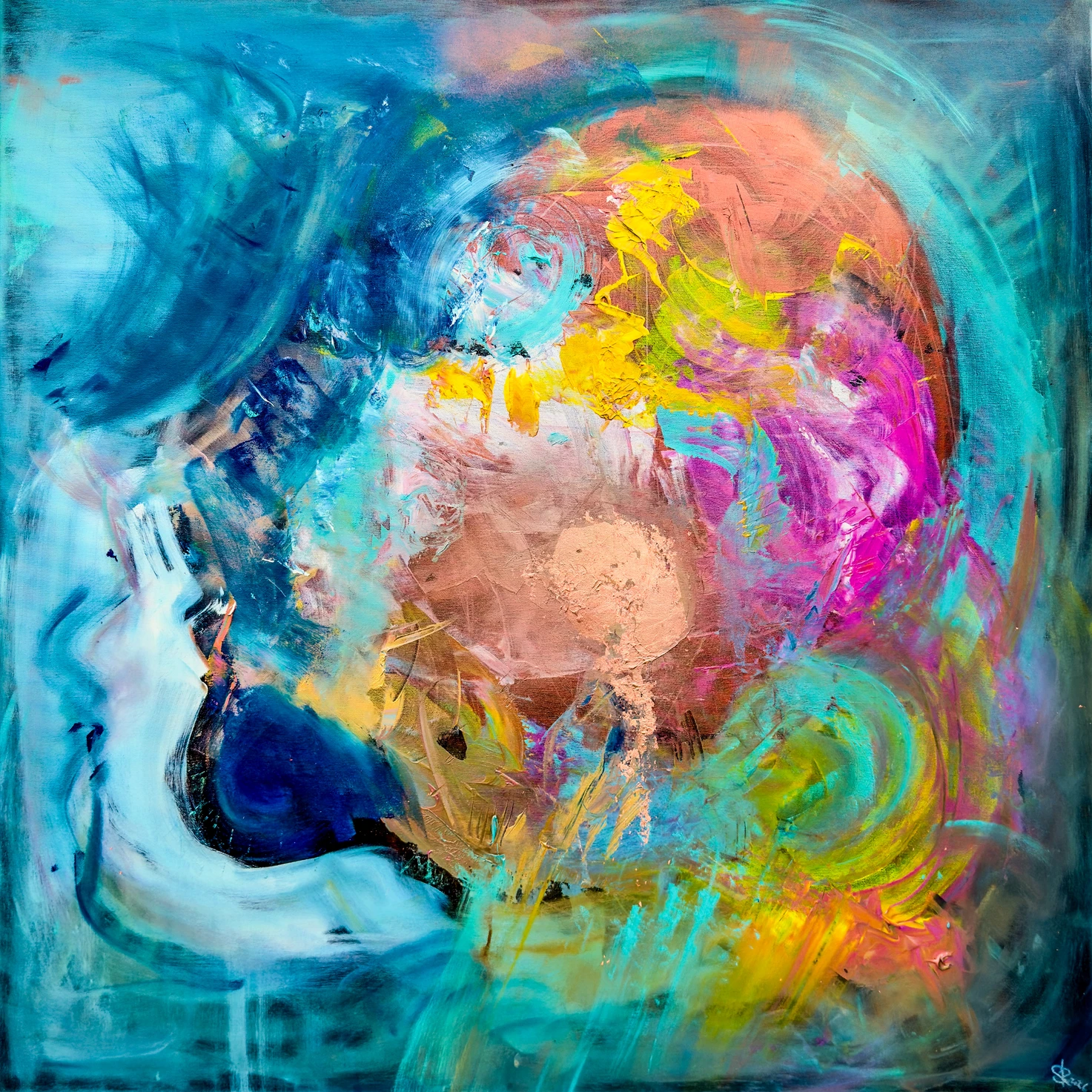
Has there ever been a moment where your intuition led you somewhere unexpected or even uncomfortable in your work? What did that reveal?
Yes, every time. Nothing is planned.
I have never expected nor planned to paint Greek goddesses.
The looks and shapes of commissioned paintings are not planned, except for me requesting certain details and some kind of connection.
Recently I realised, once I finished the latest pentalogy Becoming One, that I have mapped the psychological arc of Jungian individuation. This arc comprises two series: Journey of Acceptance (the Core Trilogy) and Journey of Recognition (Becoming One).
With regard to discomfort, it never arrives while making a painting. It is in realising, afterward, that I had painted something I had been trying not to see.
Ananke was perhaps the most uncomfortable. She means necessity — the figure who arrives when truth can no longer be avoided. Her poem says:
“You do not want me, I am here
Screaming loud and crispy clear”
I wrote those words not as an observation. I wrote them because they arrived during painting. The discomfort of that painting — the energy in it — used to make me feel very uneasy. That something you can feel whilst standing in front of her.
After work with my coach and many realisations, I suddenly do not mind her. She no longer scares me. I actually really like her and her message. I have also noticed that viewers usually react to those paintings based on events and stages of their lives. I find that fascinating. Sometimes it feels like an exciting research.
That is the particular intelligence of intuitive work: it knows before you do. It bypasses the protective editing of the conscious mind.
What we most resist is often what we most need to pass through. And the resistance itself is a kind of preparation for the encounter.
How do you recognise the difference between fear and intuition when you’re in the middle of creating something vulnerable?
In my case fear reaches toward self-doubt. Toward clear lines that do not feel authentic to me. Something safe. But not unique. Without the unique energy that makes my work what it is.
Fear makes me want to analyse it, change it, to give up, to judge myself, to create something that is not authentic for me.
Fear is concerned with outcome. With how it will be received. Whether it will be enough. Fear looks forward and backward at the same time. It is rarely present.
Intuition is quieter. It does not argue. It simply knows. It arrives with the quality of a knowing that doesn’t need to be argued into existence.
When intuition speaks, something feels right. I feel peace. I reach for a particular material, a colour, a specific corner of the canvas.
When I feel uncertain, I ask my body rather than my mind. I listen to music. I dance. I close my eyes. Sometimes I indeed paint and draw with closed eyes.
My body knows. My brain does not.
My brain never used to understand that every one of us is a unique piece of canvas.
Your work blends painting and poetry. Do the words arrive before the image, after it, or do they emerge together from the same emotional source?
Both, and neither.
I should first mention that I started writing poetry as far back as I can remember, and sometimes I turn my feelings and observations into poems without realising. I have written hundreds of poems. It feels very natural to me to express myself that way. Recently I realised that I wrote around 150 poems since 2022. I am still digesting it and starting to contemplate what to do with it as it seems to map a certain journey also.
Poems just arrive in my head and I have to stop whatever I am doing to write them down. I have learned hard lessons from not following the calling, as later I could not put together that “fantastic” piece.
It can become a little annoying sometimes. But I am deeply grateful for it regardless.
I believe that paintings and poetry emerge from the same source — just through different doors. Sometimes a complete poem arrives whilst painting, sometimes right before or after, sometimes only certain words keep repeating over and over.
Euphrosyne was like this. The moment her face appeared in the painting — at that point I actually closed my eyes, so her face is truly intuitive.
“Catch my feeling
You can follow
Once you’re seeing
Through your sorrow.”
I did not write that. She handed it to me.
Whether it was a message from her, or from somewhere deep inside me that had been waiting — I am not sure the distinction matters.
It arrived. I received it.
Poems connected to paintings are usually not my words about them. They are words the painting has been trying to say about our journeys. About our struggles, our falls, the feelings most of us feel at some moment of our lives. Like they are trying to say: “there is nothing wrong with you”. Despite all of us being a unique piece of canvas, I believe we still compare one to another. And we think there is something wrong with falling, learning, being different.
The painting and the poem are not two records of the same thing.
They are two voices of the same truth.
One speaks what the other cannot. Together they are one work.
The door is different. The room is the same.
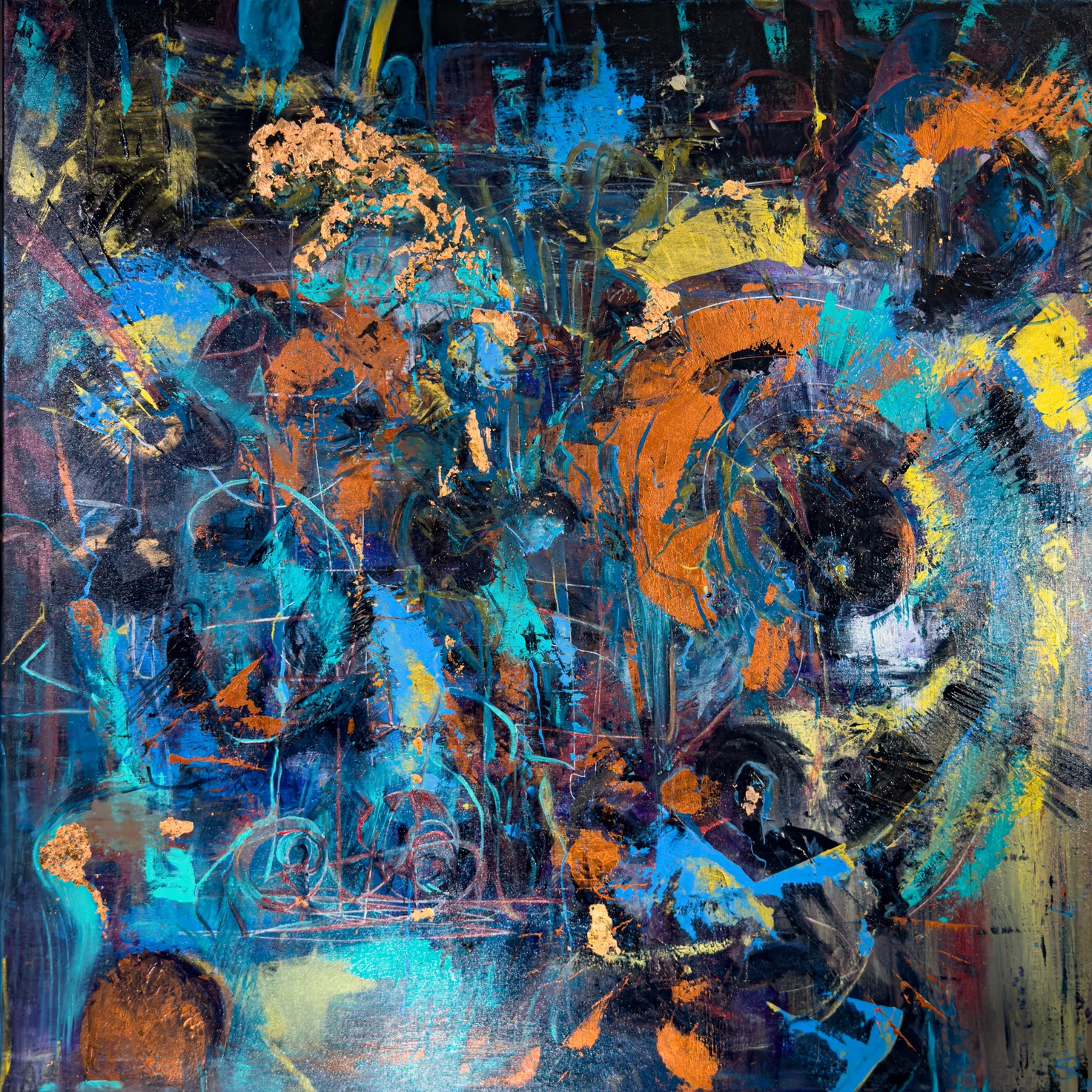
Do you believe intuition can be strengthened like a muscle, or is it something we are either born trusting or not?
Strengthened, for sure.
Not in the way a muscle is — through adding force. More in the way a channel is cleared — through removing obstruction. And through trust.
I believe that every child is born with intuition fully intact. No comparison to what the correct response should be. Not too much noise from information overload or fear.
That capacity does not disappear. It gets covered over. By training. By correction. By the accumulated weight of being told that feelings are unreliable and should be contained, that instinct is a feeling and not a proven fact or a pre-walked path of someone else.
For me, strengthening intuition has meant trusting the first response before the second thought arrives. Acting on the pull toward any tool or colour before the mind explains why that makes no sense. Working with a Jungian life coach — the slow, careful excavation of the layers of the adaptive self, the versions of me shaped by other people’s expectations — and finding what was always underneath.
The goddesses themselves are the clearest evidence.
Every one arrived before I understood why.
Lethe, Tyche, Ananke — I did not plan them.
Theia, Aphrodite, Sophrosyne, Persephone, Euphrosyne — I did not plan them either.
Intuition was already painting the series. I was simply the last to be told.
Many people say they are “not creative.” Do you think creativity is a skill, a mindset, or a willingness to listen to oneself?
A willingness to listen. Above everything else. To themselves. Not to the fear of other people’s judgements. And not to their own.
Willingness requires one thing, almost uncomfortable in its simplicity: the willingness to not already know the answer.
I look at the world around me. The sadness. The quiet weight people carry. Social media has built a gallery of perfection — and perfection is not the truth of a life. It is the performance of one.
People measure themselves against those images. And they fall short. Not because they are less. Because the comparison itself is a lie. Is it really needed?
This is part of why I paint. I see what that pressure does to people. What it did to me.
And I believe that art — honest, imperfect, feeling-first art — can be part of the answer. In my opinion there is a real connection between art and healing. Not only as therapy in a clinical sense, but as a practice of honest attention — of sitting with your own experience and finding a form other than words and thoughts.
That act — however imperfect the result — is already the thing itself.
The people who say they are not creative are always able to paint. I have had several friends join me to paint — there is always so much surprise and satisfaction once they lose their fear. Who has ever said that art must be perfect? And what is perfect? What is perfect for me is not perfect for you. Every one of us is beautifully unique.
People do not lack creativity. They lack permission.
Creativity is not the production of impressive things. It is the willingness to be honestly present with your own experience and to find a form for it.
Every human being is capable of this. Every single one.
Not elite. Not talent.
Just the willingness to look at what is actually there in you — and try to put it somewhere outside yourself.
When you finish a piece, how do you know it is complete? Is there a technical signal, or is it a quieter internal knowing?
There is a specific quality of quiet that arrives.
The canvas stops asking.
During the making, there is a conversation. The canvas asks and I respond. Something is missing and I find it. Active demands — of colour, of movement, of attention. And when it is complete, the demands stop. A stillness settles into the surface.
Not emptiness. Fullness that has become still.
But finished does not mean static.
I mix metallic acrylics directly into the paint — not as a decorative effect. The paint itself responds to the light around it. The colours change from within.
The painting you encounter at dawn is not the one you will meet at midnight.
Each canvas carries multiple emotional states at once. Light and the state of your mind decide which one speaks to you today.
That transformation is not a lighting effect. It is embedded in every brushstroke — each one placed by trusting. By following intuition. By surrendering to something I do not fully comprehend.
And the possibility of different truths, for me, has always been the signal that matters.
And sometimes the work is not finished when the canvas is.
The idea for the interactive experience with my poetry, paintings and assigned music, came to me after a meditation. Not planned. Not searched for. It arrived — the way the goddesses do.
The pentalogy had always wanted to be entered, felt, not only seen. Now it can be. Visitors step inside the world of Journey of Recognition -Becoming One. The five goddesses, the five thresholds — and discover what each one asks of them.
Same for Journey of Acceptance which I am finalising now.
“Do you see the same color I see?”
What comes through most clearly in this conversation is that intuition is not something loose or accidental. It is something earned through letting go of control, again and again, until what remains is honest.
Simona Ray does not approach her work as something to construct or perfect. She approaches it as something to receive. That shift changes everything. It removes the need to prove anything and replaces it with the responsibility to listen, even when what arrives feels unfamiliar or uncomfortable.
There is tension in that process. Intuition does not always lead somewhere easy. It often brings you closer to the things you have been avoiding, the parts of yourself that are not yet resolved. But that is exactly where the work becomes real. Not when it looks right, but when it feels true.
What she challenges, without forcing it, is the idea that creativity belongs to a select few. It does not. It belongs to anyone willing to sit with themselves long enough to hear something underneath the noise. Most people are not lacking creativity. They are lacking permission.
And that is where this conversation lingers. In the space between control and trust. Between what is expected and what is actually there. Because when you stop trying to shape everything into something acceptable, something else has the chance to appear.
Not perfect. Not finished. But alive.
Continue Reading
More In Conversation With
Dr. Sima on Reclaiming the Female Body and Why Silence Was Never Neutral
Dr. Sima on Why Intimate Wellness Is Beauty’s Most Overlooked Frontier
Do You See the Same Colour I See? Simona Ray on Portraiture, Presence, and the Art of Truly Seeing
To Look Is Easy. To See Is Everything: Simona Ray on Presence and the Art of Attention

Stories worth your
weekend.
A handpicked dispatch from Hinton's editors. The long reads, the people, the openings, the things worth knowing. No filler.